


DPDP Compliance for BFSI: Building Trust in India’s Digital Financial Ecosystem

Introduction
Trust has always been the foundation of the Banking, Financial Services and Insurance (BFSI) sector. Every savings account, insurance policy, loan application and investment portfolio represents far more than a financial transaction, it reflects a customer’s confidence that their personal information will be handled responsibly.
As India’s financial ecosystem rapidly embraces digital banking, UPI, Account Aggregators, embedded finance, AI-driven lending and hyper-personalised customer experiences, the volume of personal data being collected and processed has grown exponentially. Financial institutions today manage everything from KYC records and financial statements to transaction histories, behavioural analytics and biometric authentication. While this data enables innovation and better customer experiences, it also increases the responsibility to protect it.
This is where the Digital Personal Data Protection (DPDP) Act, 2023 marks a significant shift. Rather than introducing another standalone compliance requirement, the Act establishes a common privacy framework for organisations processing digital personal data across industries. For banks, NBFCs, insurance providers and fintech companies, it complements existing regulatory obligations issued by the Reserve Bank of India (RBI), Securities and Exchange Board of India (SEBI), Insurance Regulatory and Development Authority of India (IRDAI) and other sectoral regulators.
The focus is no longer limited to securing data against cyber threats. Organisations must now demonstrate that personal data is collected transparently, processed for legitimate purposes, protected throughout its lifecycle and managed in a manner that respects the rights of individuals.
For the BFSI sector, DPDP compliance is therefore not just a legal obligation, it is becoming an essential component of operational resilience, digital trust and long-term business growth.
Why the BFSI Sector is at the Centre of DPDP Compliance
Few industries process personal data at the scale and sensitivity of the BFSI sector. Every customer interaction, whether opening a bank account, applying for a loan, purchasing insurance or making a digital payment creates multiple data points that must be securely collected, processed and retained.
Unlike retail or e-commerce businesses, financial institutions maintain customer relationships over many years, often decades. During this period, they accumulate a comprehensive digital profile comprising identity documents, financial records, credit history, investment preferences, transaction behaviour, nominee information, income details and risk assessments. When analysed together, this information provides an exceptionally detailed picture of an individual’s financial life, making it one of the most sensitive categories of personal data processed by any industry.
This complexity is further amplified by the evolving financial ecosystem. Modern banking increasingly relies on interconnected platforms involving payment service providers, fintech companies, credit bureaus, KYC vendors, cloud service providers and AI-powered fraud detection systems. Personal data now moves across multiple systems and third-party organisations before a single financial transaction is completed. As these ecosystems become more interconnected, maintaining visibility and accountability over customer data becomes significantly more challenging.
The DPDP Act addresses this challenge by placing accountability on organisations that determine how and why personal data is processed. For the BFSI sector, this means privacy can no longer be treated solely as a cybersecurity initiative or a compliance checklist. It must become an integral part of business operations, technology architecture and customer experience.
The implications extend beyond regulatory compliance. Customers today are increasingly aware of how organisations use their personal information. A privacy incident can damage customer confidence far more quickly than ever before, while organisations that demonstrate transparency and responsible data practices are more likely to strengthen customer loyalty and brand reputation.
This is why DPDP compliance for banks, NBFCs and insurance companies is emerging as a strategic business priority rather than simply a legal requirement.
How the DPDP Act Changes Compliance for Banks and Financial Institutions
Although the BFSI sector has long operated under regulatory frameworks governing cybersecurity, outsourcing, KYC and operational risk, the DPDP Act introduces a different perspective. It shifts the focus from organisational obligations alone to the rights of the individual whose personal data is being processed.
For financial institutions, this requires a more holistic approach to data governance, one that considers not only how data is protected, but also why it is collected, how it is used and whether customers have been informed appropriately.
One of the most significant changes relates to consent management. Historically, consent was often embedded within lengthy account-opening forms or standard terms and conditions. Under the DPDP framework, organisations must ensure that privacy notices are clear, accessible and presented in a manner that enables individuals to understand the purpose of data collection. Where consent forms the legal basis for processing, customers should also be able to withdraw it as easily as it was provided.
This shift requires organisations to move beyond manual processes and adopt structured Consent Management practices that can record, update and demonstrate consent across multiple customer touchpoints. For institutions offering digital banking services or customer portals, integrating effective consent management also supports a more transparent customer experience.
The Act also reinforces the principle of purpose limitation. Personal data collected for regulatory obligations such as KYC verification, fraud prevention or credit assessment should not automatically be repurposed for unrelated business activities unless supported by an appropriate legal basis. This encourages organisations to establish stronger governance around how customer information is shared across departments and business functions.
Another important consideration is data minimisation. Financial institutions have traditionally collected extensive customer information to support future business requirements. Under the DPDP framework, organisations are expected to collect only the personal data that is necessary for a clearly defined purpose. Apart from supporting compliance, this approach also reduces storage costs, simplifies governance and limits the impact of potential data breaches.
The Act also strengthens the rights of individuals by enabling them to seek access to their personal information, request corrections, withdraw consent where applicable and raise grievances regarding the processing of their data. For banks and financial institutions managing millions of customer records, responding efficiently to these requests requires well-defined operational workflows rather than manual intervention. Establishing automated processes for managing Data Principal requests becomes essential for maintaining both compliance and customer trust.
Finally, the DPDP Act reinforces accountability across the broader financial ecosystem. Banks increasingly rely on external service providers for cloud infrastructure, payment processing, customer verification, fraud analytics and digital lending. While these partnerships drive innovation, they also increase privacy risk. Financial institutions must therefore establish stronger oversight over third-party data processing, ensuring that customer information remains protected throughout the entire data lifecycle.
Collectively, these changes signal an important transition for the BFSI sector. Compliance is no longer measured solely by the presence of security controls or regulatory documentation. It increasingly depends on an organisation’s ability to demonstrate responsible data governance, transparent privacy practices and continuous accountability across every stage of personal data processing.
The Biggest DPDP Challenges for BFSI Organisations
For most financial institutions, the challenge isn’t understanding the Digital Personal Data Protection (DPDP) Act, it’s implementing it across complex, interconnected environments. Banks, NBFCs and insurance companies operate on decades of accumulated systems, regulatory obligations and third-party relationships. Achieving DPDP compliance for BFSI therefore requires more than policy updates; it demands visibility, governance and operational consistency across the entire data lifecycle.
One of the biggest hurdles is fragmented data. Customer information is often distributed across core banking platforms, CRM systems, loan management applications, payment gateways, cloud environments and legacy databases. Without knowing where personal data resides, organisations cannot effectively fulfil obligations related to consent, retention or Data Principal rights. This is why Data Discovery forms the foundation of every successful privacy programme. By automatically identifying and classifying personal data across structured and unstructured environments, organisations gain the visibility needed to strengthen governance and reduce compliance risk.
Understanding where data exists is only part of the equation. Financial institutions must also know how personal information moves across their organisation. Every interaction between business units, third-party vendors, fintech partners and regulatory systems creates a new data flow that needs to be documented and governed. Implementing a comprehensive Data Mapping framework enables organisations to visualise these data flows, identify unnecessary processing activities and demonstrate accountability under the DPDP Act. More importantly, it helps compliance teams understand exactly where customer information is collected, processed, shared and retained.
Another area requiring careful attention is data retention. Financial institutions are required to retain certain records under regulations such as the Prevention of Money Laundering Act (PMLA), RBI guidelines and tax laws. At the same time, the DPDP Act reinforces the principle that personal data should not be retained indefinitely once its purpose has been fulfilled. Balancing these obligations requires clearly defined retention schedules, governance policies and defensible deletion processes that distinguish between statutory requirements and operational convenience.
The rapid adoption of Artificial Intelligence across banking has introduced another layer of complexity. AI is increasingly used for fraud detection, credit underwriting, customer service, personalised product recommendations and risk modelling. While these technologies improve efficiency, they also rely on large volumes of personal data. Organisations must therefore ensure that AI initiatives remain aligned with the principles of transparency, purpose limitation and accountability established under the DPDP Act. As AI adoption accelerates, privacy and governance will become essential components of responsible innovation rather than afterthoughts.
Finally, third-party risk continues to grow across the financial ecosystem. From payment processors and KYC providers to cloud platforms and analytics partners, customer information routinely moves beyond organisational boundaries. The responsibility for protecting that data, however, remains with the organisation that determines its purpose and means of processing. Effective vendor governance, contractual controls and continuous oversight are therefore critical for maintaining both regulatory compliance and customer trust.
Given the volume and sensitivity of data they handle, many BFSI organisations are likely to be classified as Significant Data Fiduciaries (SDFs) under the DPDP Act. This classification is based on factors such as the volume and sensitivity of personal data processed, the risk of harm to Data Principals and the potential impact on India’s sovereignty and electoral integrity, thresholds that large banks, NBFCs and insurers routinely meet through KYC records, financial transaction histories, credit information and other sensitive personal data. SDF status brings a heightened set of obligations, including appointing a Data Protection Officer based in India who reports directly to the organisation’s board, engaging an independent data auditor, conducting periodic Data Protection Impact Assessments (DPIAs) and undergoing regular compliance audits. For BFSI institutions, this means privacy governance can no longer be managed as a background function, it requires board-level visibility, dedicated resourcing and documented processes that can withstand external audit scrutiny.
Collectively, these challenges demonstrate why DPDP compliance for banks and financial institutions cannot be achieved through isolated compliance initiatives. It requires an integrated approach that combines technology, governance and operational accountability.
Building a DPDP-Ready BFSI Organisation
While every financial institution will approach compliance differently, the organisations that are progressing most effectively share one common characteristic, they treat privacy as a continuous governance function rather than a one-time compliance project.
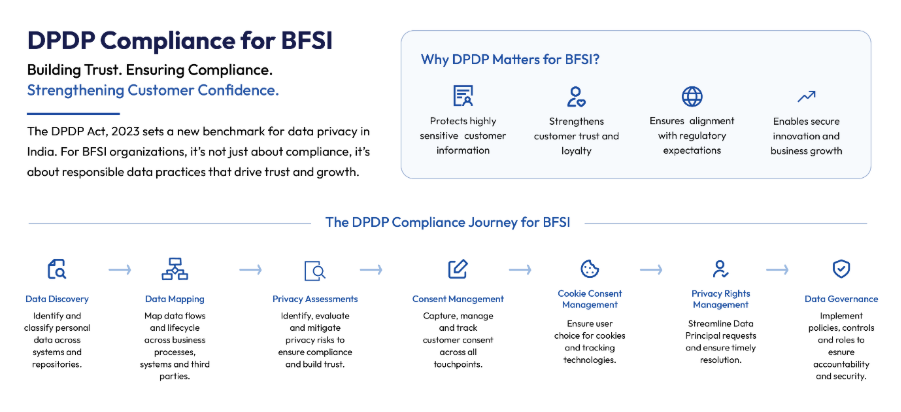
The journey begins with establishing complete visibility over personal data. Before organisations can respond to customer requests, manage consent or implement retention policies, they must first know what personal data they hold, where it is stored and who has access to it. Automated Data Discovery helps create this visibility by continuously identifying sensitive personal information across enterprise systems, cloud environments and endpoints. This enables compliance teams to move from assumptions to evidence-based governance.
Once personal data has been identified, organisations need to understand how it moves throughout the business. Customer information rarely remains within a single application. It passes through onboarding systems, payment infrastructure, fraud detection engines, customer support platforms, reporting tools and external partners. Maintaining an accurate Data Mapping framework provides a complete picture of these processing activities, helping organisations demonstrate accountability while reducing unnecessary exposure of personal information.
With visibility and data flows established, organisations must then assess the risk associated with their processing activities. A structured Privacy Assessment, or Data Protection Impact Assessment (DPIA), helps identify high-risk processing activities, evaluate potential harm to Data Principals and determine whether existing safeguards are adequate before new products, systems or vendor relationships go live. Conducting privacy assessments early allows organisations to build privacy by design into new initiatives rather than retrofitting controls after deployment, and provides the documented evidence needed to demonstrate accountability to regulators. This risk-based understanding also informs where consent controls, access restrictions and additional safeguards should be prioritised across the organisation.
Managing consent has become equally important. As financial institutions expand their digital services, customer interactions increasingly occur across mobile applications, internet banking platforms, insurance portals and online onboarding journeys. A centralised Consent Management Platform allows organisations to capture, manage and update customer consent across these touchpoints while maintaining a verifiable audit trail. This not only supports compliance with the DPDP Act but also improves transparency and customer confidence by giving individuals greater control over how their personal information is used.
For organisations operating customer-facing websites and digital portals, privacy extends beyond forms and applications. Cookies and online tracking technologies also play an important role in the collection of personal data. Implementing compliant Cookie Consent Management ensures that organisations provide clear information about tracking technologies while enabling users to manage their preferences in accordance with applicable privacy requirements.
As awareness of privacy rights continues to grow, organisations must also be prepared to respond efficiently to customer requests related to access, correction, erasure and grievance redressal. Manual processes often struggle to meet regulatory expectations while maintaining consistency and auditability. Implementing automated DSAR Management enables organisations to manage these requests through structured workflows, improving response times while creating a complete record of compliance activities.
Strong governance is what brings these capabilities together. An effective Data Governance framework establishes clear ownership, standardised policies, access controls, data classification standards and lifecycle management processes across the organisation. Rather than treating privacy as an isolated legal requirement, governance embeds accountability into everyday business operations and creates a consistent approach to managing personal information across the enterprise.
Ultimately, DPDP compliance for BFSI is achieved not through individual controls, but through an integrated privacy programme that combines data visibility, governance, consent management and operational accountability. Organisations that invest in these capabilities today will be better positioned to respond to evolving regulatory expectations while strengthening trust across every customer interaction.
Privacy as a Business Strategy, Not Just a Compliance Requirement
Privacy is often viewed through the lens of regulatory compliance, but for the BFSI sector, its business impact extends much further. Financial institutions operate in an environment where trust directly influences customer acquisition, retention and long-term relationships. As digital services become the primary channel for banking and financial interactions, customers increasingly expect organisations to handle their personal data with the same level of care as they manage their finances.
The DPDP Act reinforces this shift by encouraging organisations to build transparency into every stage of the customer journey. Clear privacy notices, meaningful consent mechanisms and responsible data handling are no longer simply legal requirements, they have become important indicators of organisational credibility. Customers are more likely to engage with institutions that demonstrate accountability in how personal information is collected, used and protected.
This is particularly relevant as AI, Open Finance, embedded banking and digital lending continue to reshape the industry. Innovation depends on data, but sustainable innovation depends on responsible data governance. Organisations that embed privacy into product design, technology architecture and business processes are likely to adapt more effectively to future regulatory changes while reducing operational risk and strengthening stakeholder confidence.
Privacy also delivers measurable business value beyond compliance. A mature privacy programme improves data quality, reduces duplication, strengthens governance, simplifies audits and enables faster responses to customer requests. It supports better decision-making by ensuring that personal data is accurate, appropriately classified and managed throughout its lifecycle. In many organisations, privacy has evolved from a legal obligation into a strategic enabler of digital transformation.
For banks, NBFCs and insurance providers, the question is no longer whether privacy is important. The real question is how effectively it can be integrated into the organisation’s culture, operations and technology strategy. Those that view DPDP compliance as an opportunity to strengthen customer trust, rather than simply satisfy regulatory requirements will be better positioned to build resilient, future-ready businesses in India’s rapidly evolving digital economy.
Conclusion: Building a Privacy-First Financial Ecosystem
The Digital Personal Data Protection (DPDP) Act marks an important milestone in India’s evolving privacy landscape, but for the BFSI sector, it represents something much larger than regulatory compliance. It signals a shift towards greater accountability, transparency and responsible data stewardship in an industry where trust has always been the foundation of every customer relationship.
As banks, NBFCs and insurance providers continue to accelerate digital transformation, personal data will remain at the centre of innovation. Whether it is AI-powered financial services, embedded finance, digital lending or real-time payments, every advancement depends on customers having confidence that their information is being collected, processed and protected responsibly.
Achieving DPDP compliance for BFSI therefore requires more than implementing individual controls or updating privacy policies. It demands a structured privacy programme built on visibility, governance and accountability. Organisations need to know what personal data they hold, where it resides, how it moves across the business and who has access to it. They must also be prepared to manage customer consent, respond to Data Principal requests, govern third-party data sharing and establish clear retention practices that align with both the DPDP Act and sector-specific regulatory requirements.
This is where technology and governance must work together. Solutions such as Data Discovery, Data Mapping, Data Assessment, Consent Management, Cookie Consent Management, Data Governance and DSAR Management enable financial institutions to operationalise privacy across the enterprise rather than treating it as a standalone compliance function. Together, these capabilities help organisations reduce operational risk, improve regulatory readiness and strengthen customer trust.
Ultimately, organisations that view privacy as a strategic business capability, not merely a legal obligation will be better positioned to build resilient, customer-centric and future-ready financial services. In an increasingly data-driven economy, privacy is no longer just about protecting information; it is about protecting relationships.
Strengthen Your DPDP Readiness with Privacy Pillar
Building a mature privacy programme requires more than interpreting regulations, it requires the ability to translate them into operational processes that scale with your business.
Privacy Pillar helps banks, NBFCs, insurance providers and other regulated organisations simplify DPDP compliance through integrated privacy and governance solutions. From discovering and mapping personal data to managing customer consent, automating Data Principal requests and strengthening enterprise-wide data governance, our platform helps organisations embed privacy into everyday business operations while supporting long-term compliance and customer trust.
Explore Privacy Pillar’s solutions to build a privacy-first foundation for your organisation – Book a Demo
References
- Ministry of Electronics and Information Technology (MeitY) Digital Personal Data Protection Act, 2023
- Reserve Bank of India (RBI) Master Direction on Information Technology Governance, Risk, Controls and Assurance Practices.
- Reserve Bank of India (RBI) Digital Lending Guidelines
- Reserve Bank of India (RBI) Master Direction – Know Your Customer (KYC)
- Securities and Exchange Board of India (SEBI) Cybersecurity and Cyber Resilience Frameworks
- Insurance Regulatory and Development Authority of India (IRDAI) Information and Cyber Security Guidelines
- Indian Computer Emergency Response Team (CERT-In) Directions relating to Information Security Practices, Procedure, Prevention, Response and Reporting of Cyber Incidents